
Still in Pain After Physiotherapy or Massage Therapy? Discover Gentle Japanese Acupuncture
Understanding Traditional Chinese Medicine, Qi and Blood balance, and a gentle, whole-body approach to recovery.
By Apollo Wellness Team
Category: Acupuncture | Persistent Pain | Japanese-Style Acupuncture
Updated: October 20, 2026
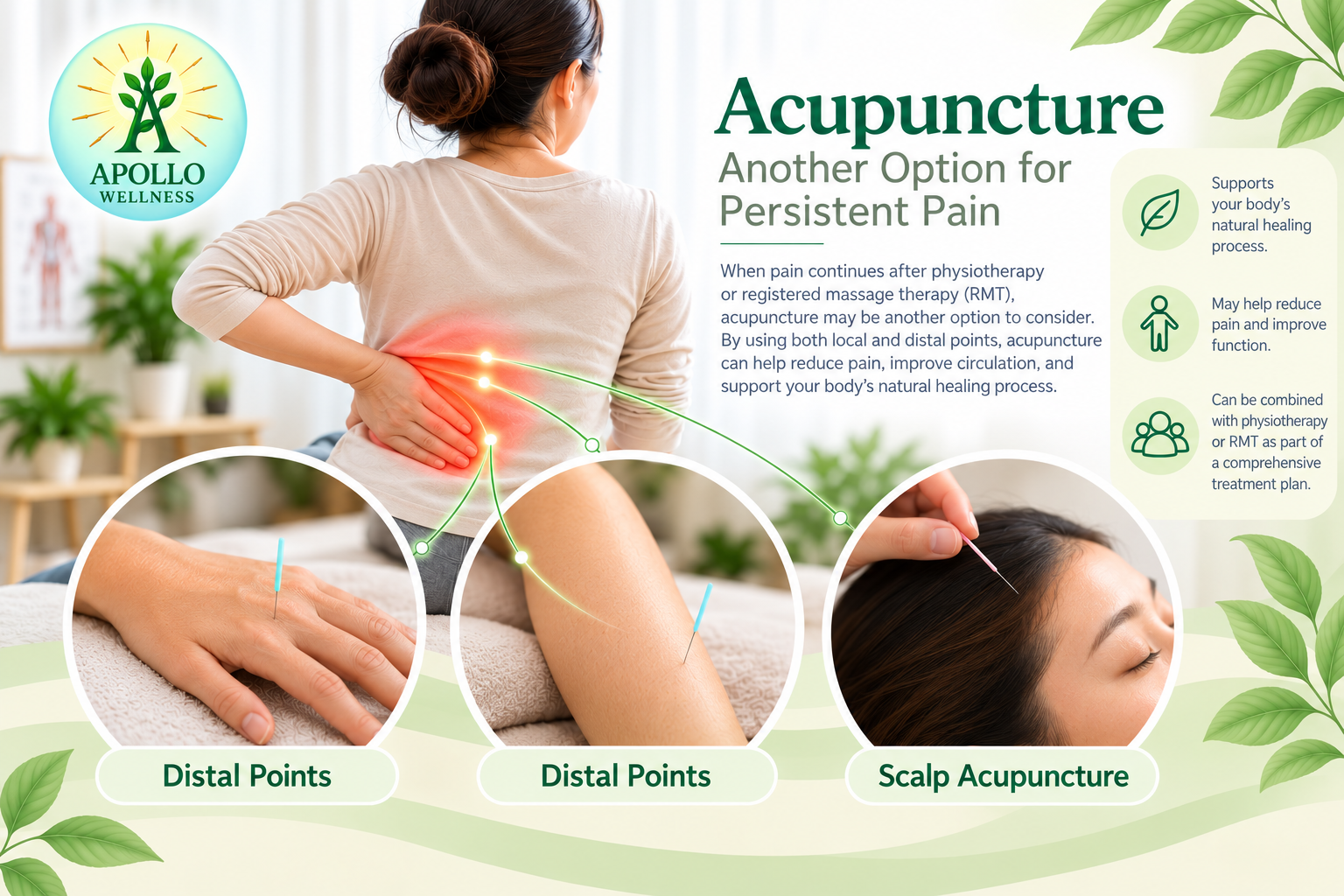
Looking for Another Approach to Persistent Pain?
Physiotherapy and registered massage therapy (RMT) are common treatment choices for people experiencing neck pain, shoulder tension, lower-back pain, and other musculoskeletal concerns.
Many people benefit from these treatments. However, some continue to experience persistent or recurring discomfort despite trying physiotherapy or massage therapy.
If you are exploring other treatment options, acupuncture may be worth considering.
For many people, the biggest hesitation is the fear of needles. They imagine acupuncture will be painful or uncomfortable.
However, gentle Japanese-style acupuncture may be very different from what they expect.
At Apollo Wellness, we use exceptionally fine Japanese acupuncture needles and gentle techniques. Many patients report feeling no pain during treatment, and some become so relaxed that they naturally fall asleep.
Physiotherapy, RMT, and Acupuncture: Different Approaches
Physiotherapy commonly focuses on improving movement, strength, physical function, and rehabilitation.
Registered massage therapy uses hands-on techniques to address soft-tissue discomfort, muscle tension, and related musculoskeletal concerns.
Traditional Chinese Medicine (TCM) acupuncture approaches treatment from a different perspective.
Rather than focusing only on the painful area, TCM considers the individual's overall condition, the balance of Qi and Blood, meridian relationships, and patterns of imbalance.
These approaches do not necessarily compete with one another. Depending on the individual's needs, they may play complementary roles in a broader treatment plan.
Why Does Traditional Chinese Medicine Focus on Qi and Blood?
In Traditional Chinese Medicine, Qi and Blood are fundamental concepts used to understand the body's functional activity, nourishment, and internal balance.
A classical TCM principle states:
“Where there is obstruction, there is pain; where there is free flow, there is no pain.”
According to TCM theory, pain may be associated with patterns such as Qi stagnation, Blood stasis, or Cold-related obstruction that interfere with the free flow of Qi and Blood through the meridians.
Other patterns of pain may arise when tissues are insufficiently nourished, traditionally described by the principle of pain associated with deficiency.
Acupuncture aims to regulate Qi and Blood, promote meridian flow, and restore balance according to each patient's individual presentation.
These concepts belong to the traditional Chinese medical framework and are distinct from modern anatomical explanations.
Why Might Acupuncture Points Be Selected Away from the Painful Area?
One distinctive feature of acupuncture is distal point selection.
For example, a practitioner may select acupuncture points on the hands, arms, legs, or feet when treating neck, shoulder, or lower-back discomfort.
In TCM, these choices are guided by meridian relationships, Qi and Blood patterns, and individualized assessment.
This whole-body perspective means acupuncture treatment does not always require needles to be inserted directly into the painful area.
What Is Scalp Acupuncture?
Scalp acupuncture is another specialized approach that may be incorporated into an individualized treatment plan.
Depending on the acupuncture system and clinical assessment, selected areas of the scalp may be used as part of treatment for pain or certain functional concerns.
Scalp acupuncture is not necessary for every patient. Its clinical evidence varies according to the condition being treated.
Along with local and distal point selection, scalp acupuncture illustrates the range of techniques available within acupuncture practice.
Afraid of Needles? Gentle Japanese Acupuncture May Surprise You
Many people associate needles with injections or blood tests and assume acupuncture will feel similar.
Acupuncture needles are much finer.
At Apollo Wellness, our gentle Japanese-style acupuncture approach emphasizes delicate needling techniques, patient comfort, and individualized stimulation.
Many of our patients report feeling no pain during treatment.
Some may notice a brief sensation when a needle is inserted, while others feel little or nothing.
Some patients become deeply relaxed during their sessions and naturally fall asleep.
Our approach does not rely on strong or painful stimulation. Treatment is adjusted according to each patient's comfort and sensitivity.
For people who have avoided acupuncture because of fear of needles, gentle Japanese acupuncture may be a reassuring introduction. Learn more on our Japanese-style acupuncture page.
Supporting the Body's Natural Regulation and Recovery
From a Traditional Chinese Medicine perspective, acupuncture aims to harmonize Qi and Blood, support meridian balance, and encourage the body's natural capacity for regulation and recovery.
Modern research has also investigated acupuncture-related responses involving sensory nerves, pain-modulating pathways, autonomic regulation, and neuroimmune signaling.
Clinical evidence supports acupuncture as an option for certain chronic pain conditions, although individual responses and outcomes vary.
These traditional and modern perspectives provide different ways of understanding acupuncture. For a deeper research overview, see Acupuncture and the Body's Natural Healing and Recovery Mechanisms.
Acupuncture Is a Gradual, Individualized Process
Acupuncture treatment is generally approached as a gradual process rather than a one-session solution.
Some patients may notice changes early in treatment, while others may require a longer course before meaningful improvement becomes apparent.
Treatment plans are adjusted according to the patient's symptoms, response, and progress over time.
The aim is to support steady, individualized improvement rather than promise immediate results.
When Might You Notice Changes After Acupuncture?
Responses to acupuncture vary from person to person.
Some patients notice pain relief immediately after treatment. Others may begin to feel improvement gradually over the following few hours, while some notice changes later that day or the next day.
The timing and degree of improvement depend on individual circumstances, including the nature of the condition and the person's response to treatment.
Acupuncture is generally an individualized, progressive treatment process. Although some patients experience early relief, others may benefit from a series of treatments, with progress assessed and treatment adjusted over time.
When Might Acupuncture Be Worth Considering?
If you have tried physiotherapy or massage therapy and continue to experience recurring discomfort, acupuncture may offer another approach to explore.
It does not necessarily need to replace your existing care. Depending on your condition, acupuncture may be considered alongside rehabilitation, exercise, massage therapy, or other appropriate treatment.
Persistent, worsening, or unexplained symptoms should also be medically reassessed when appropriate.
Experience Gentle Japanese Acupuncture at Apollo Wellness
At Apollo Wellness, we combine Traditional Chinese Medicine assessment with gentle Japanese-style acupuncture techniques.
Our individualized approach may include local acupuncture points, distal point selection, or scalp acupuncture when appropriate.
We focus on patient comfort, whole-body balance, and gradual recovery.
If you are curious about acupuncture but have been hesitant because of needles, we invite you to discover a gentler treatment experience.
Prefer No Needles? Consider Laser Acupuncture
For patients who are especially uncomfortable with needles, Apollo Wellness also offers laser acupuncture, a non-invasive approach that uses low-level light stimulation at selected acupuncture points without inserting needles.
Laser acupuncture provides a needle-free option for people who wish to explore acupuncture-based care while avoiding needle insertion.
Because laser acupuncture uses a different form of stimulation, the treatment plan and number of sessions may differ from traditional needle acupuncture. At Apollo Wellness, laser acupuncture may require a longer course of treatment, depending on the condition and individual response.
Our practitioner can discuss whether gentle Japanese needle acupuncture or laser acupuncture is more appropriate for your needs.
Learn More and Book an Appointment
This article is intended for general education and does not replace individualized medical assessment or advice.